by Amineddoleh & Associates LLC | Dec 13, 2016 |
As the law firm continues to expand, Amineddoleh & Associates LLC is pleased to announce a new member of its team, Katherine Brennan. She has already joined us working on matters related to art forgeries at auction and the restitution of a high-value cultural heritage object abroad. Although a recent law school graduate, Katherine has already developed an impressive resume of experience in art, cultural heritage, and intellectual property law. Her work experience, academic credentials, foreign language skills, and passion for art and cultural heritage make her particularly well-suited for a position with Amineddoleh & Associates. You can read more about Katherine here.
by Amineddoleh & Associates LLC | Dec 9, 2016 |
 Art crimes are often portrayed as glamorous, without victims except for wealthy collectors. However, art crime is a multi-billion-dollar industry, with ties to crime syndicates and terrorist organizations, money laundering and extortion, violence and murder, and the narcotics and arms trades. The theft of fine art from private homes and museums often attracts the most attention. On the other end of the spectrum, the illicit trade in antiquities often go unpublicized. This trade harms humanity, destroying our collective history and memory. Crimes are committed when tomb raiders and illicit diggers loot artifacts from the ground and then sell these objects to middlemen and antiquities.
During war, millions of objects are vulnerable to theft and destruction. And since ancient times, art has been used as propaganda. Ancient rulers exhibited looted objects to demonstrate their might over enemies. But art was also obliterated for the same reasons—the destruction of art is a means to degrade an enemy or weaken opposition. Art has also been damaged to make political or social commentary. Although some art criminals remove objects from the market or destroy them, others create forgeries and sell these offending pieces at sky-high prices.
The exhibition, Art Crimes, explores the history of art crimes around the world. It is the first exhibition of its kind, exploring theft, looting, forgeries, and vandalism. Read the press release here: http://www.nyu.edu/about/news-publications/news/2016/december/_art-crime-_-a-visual-documentation-of-stolen–vandalized—-for.html
by Amineddoleh & Associates LLC | Nov 17, 2016 |
One of the challenges associated with authenticating art is that it can sometimes be difficult to procure an expert’s opinion. During the past decade, various artists’ foundations have either dismantled or decided not to provide opinions on authenticity. In addition, some experts refrain from providing advice due to fear of litigation. With the exorbitant expense of defending oneself in court, possible damage to a professional reputation, and the stress involved in litigious battles, some experts abstain from involvement in authentication disputes.
 However, in the case of van Gogh works, there is a source that willingly provides expertise—the Van Gogh Museum. This week’s publication of a sketchbook purportedly belonging to van Gogh is creating waves in the art world because the author of the text did not confer with the leading van Gogh authority. Rather than present the works to the recognized experts on the oeuvre of the artist, the author of “Vincent van Gogh: The Lost Arles Sketchbook” excluded the museum’s opinion in the book. However, the museum had repeatedly informed the owners of the sketches that they are not by the Dutch artist. The sketchbook’s anonymous owners approached the museum in 2008 and 2012 and were told that the drawings were forgeries.
The museum has definitively said that the works are fakes for three reasons: forensic anomalies, unclear provenance, and stylistic irregularities. The forensics are wrong—the materials used for the sketches are not the type used by van Gogh. The sketches feature brown pigment, where as Van Gogh used black or purple ink. What’s more, the paper used is different than the type used by the famed artist. The provenance in unreliable, as a source purporting to establish its presence in the 1890s is questionable. And even more damning is the style. The museum asserts that the sketches do not reflect the artist’s style or artistic development during the time they were supposedly drawn. They also feature “typical mistakes.” The museum states that “the person who made them is following the examples of van Gogh in a superficial way and doesn’t know what van Gogh was aiming for.”
However, the academics supporting the van Gogh attribution discuss the sketchbook’s interesting history, and the author of the academic work spent three years examining the work’s history, purportedly tracing it back to a French cafe in 1890.
The recent announcement of the sketchbook draws attention to the art world’s sometimes contentious authentication process, and the inevitable battle of experts that frequently results. However, in a market full of skillfully executed forgeries, it is surprising that any art scholar would not heavily weigh the knowledge of the leading authorities (at the Van Gogh Museum) who were ready and willing to provide valuable expertise. To read more about the authentication process and the history of forgeries, find a copy of my recent academic publication: Are you Faux Real? An Examination of Art Forgery and the Legal Tools Protecting Art Collectors.
by Amineddoleh & Associates LLC | Nov 8, 2016 |
It’s alway great news when a museum voluntarily returns a piece of cultural heritage without moving forward with a costly litigation and protracted legal battle.

Last week, it was announced that the Cleveland Museum of Art
agreed to return a leaf of an illuminated manuscript back to Italy. The page, from a 14th century hymnal, features St. Lucy. According to US Immigration and Customs Enforcements, the museum had bought the work in good faith, unaware that the page was stolen and that the Italian government was actively searching for it. Once aware of the situation, the museum negotiated with the Italian authorities and returned the leaf. The museum plans to send the piece back to Italy in time for the Feast of St. Lucy in mid-December.
Illuminated manuscripts are valuable on the art market, with some single pages valued in the tens of millions. Because of the great value, forged pages have appeared on the market. For more insights into this fascinating genre of art, three museums in Boston are presenting a collaborative 3-part exhibition, Beyond Words, focused on manuscripts. The McMullen Museum at Boston College, Houghton Library at Harvard University, and the Isabella Stewart Gardener Museum are displaying three magnificent exhibitions on these works. I had the opportunity to visit all three shows during this past week, and I was impressed by the superb curation of the exhibition, variety of manuscripts on view, and beauty of the display. The three exhibitions are on display through various dates in December and January.
by Amineddoleh & Associates LLC | Oct 4, 2016 |
The past week has been an art lawyer’s dream, with major news items about cultural heritage destruction, the recovery of stolen art, a lawsuit against a major museum, and the rediscovery of a painting by an Old Master.
Cultural Heritage Destruction and Crimes
Last Tuesday, cultural heritage made the headlines. Ahmad al-Faqi al-Mahdi faced a war crimes charge under Article 25 of the Rome Statute. This is the first time the International Criminal Court (ICC) had attempted to prosecute the “destruction of buildings dedicated to religion and historical monuments” as a war crime. In August, the trial against Al-Mahdi opened before Trial Chamber VIII at the ICC in The Hague, the Netherlands. The Malian national admitted guilt as to the war crime consisting of the destruction of historical and religious monuments in Timbuktu, Mali in 2012. He “exercised joint control over the attacks” by planning, leading and participating in them, supplying pick-axes and in one case a bulldozer.
Al-Mahdi expressed remorse for his involvement in the destruction of 10 mausoleums and religious sites in Timbuktu dating from Mali’s 14th-century golden age as a trading hub and center of Sufi Islam, a branch of the religion seen as idolatrous by some hardline Muslim groups. It was the first international trial focusing on the destruction of historical and religious monuments, and the first ICC case where the defendant admitted guilt. Last Tuesday, al-Mahdi was given 9 years in prison for his crimes. In handing down a 9-year sentence, rather than the maximum of 30 years, the judges stated that they took into account al-Mahdi’s “genuine remorse, deep regret and deep pain” and his calls on other Muslims not to make the same mistakes he had made.
Recovery of Stolen Art

Courtesy of the Van Gogh Museum, Amsterdam
On Friday, another major art announcement was made—two stolen Van Gogh paintings were recovered by Italian military police, the Carabinieri. The paintings were stolen in 2002 from the Van Gogh Museum in Amsterdam when two art thieves used a ladder to climb up to the roof of the museum, and broke into the building. The pair stole two paintings, View of the Sea at Scheveningen and Congregation Leaving the Reformed Church in Nuenen.
Last week, the paintings were recovered in Naples, Italy when authorities found the works after a sting operation to infiltrate an organized crime group, the Camorra. The paintings were stored in one of the houses of an international drug trafficker. According to press release from the Van Gogh Museum, the seascape has a patch of damage on the bottom left corner, but otherwise the paintings are in good condition. It is not known when the works will return to the Netherlands since they will likely be used as evidence in a trial.
Lawsuit against the Metropolitan Museum of Art
On Friday, the Metropolitan Museum of Art was sued over one of its most valuable Picasso works, The Actor. The estate of a German Jewish businessman, Paul Leffmann, asserts that the museum does not have good title to the painting because Leffmann was forced to sell it at a low price after fleeing the Nazis. The estate claims that the sale was made under duress. The law firm for the estate, Herrick Feinstein alleged in the court filing that the museum “did not disclose or should have known that the painting had been owned by a Jewish refugee, Paul Leffmann, who had disposed of the work only because of Nazi and Fascist persecution.” The lawyers said they had negotiated with the Met for several years, while the Met investigated the claim, but they had never been able to reach a settlement. The museum asserts the Leffmanns had made no claim on the painting after the war, when they did try to reclaim property they had been forced to sell.
Rediscovery of a Raphael
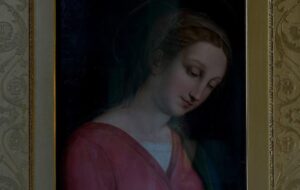 And finally, on Sunday, an interesting attribution matter was announced in the news. A painting likely to be the work of Raphael was ‘rediscovered’ in the Haddo House, in Scotland. The painting of Madonna was obscured by darkened varnish and was misattributed to a minor hand. In 1899, it was valued as a copy for just about $25 dollars. If it is truly a Raphael, it would be worth about $25 million today.
Famous art historian Bendor Grosvenor was at the Haddo House to view other paintings for a BBC television series when he was struck by the Raphael tucked away in the corner. He discovered that the painting was bought as a Raphael in the early 19th century and exhibited as such in 1841. Afterwards, it was downgraded to “after Raphael”, and eventually attributed to a minor Renaissance artist, Innocenzo Francucci da Imola.
The story of this Raphael rediscovery will be featured on 5 October in a new BBC4 series, Britain’s Lost Masterpieces, co-presented by Grosvenor.



