by Amineddoleh & Associates LLC | May 29, 2024 |
On June 12, our founder Leila Amineddoleh will speak on a Federal Bar Council CLE titled “Art & Antiquities Law Part 1: Legal Principles and Policy Issues Related to Restitution of Antiquities.” The panel will be moderated by the Honorable Gary Stein (United States Magistrate Judge, SDNY), and the speakers include Leila, Harry Sandick, Esq. (partner at Patterson Belknap Webb & Tyler LLP, and Jane A. Levine (Partner and Co-Founder of The ArtRisk Group). The panel will provide background on art general legal principles and policy issues concerning the treatment of art and cultural heritage, including their legal history and framework; jurisdictional considerations; direct actions by state sovereigns versus actions by U.S. prosecutors; and considerations for those facing restitution investigations or claims. Register here.
by Amineddoleh & Associates LLC | May 24, 2024 |

Signore Fiorilli in his office with a miniature replica of the statue (Copyright: Leila A. Amineddoleh)
For years, we’ve been followed the dispute over the Getty Bronze. In 2010, our founder had the honor of meeting and conferring with state attorney Maurizio Fiorilli. Referred to as the “scourge of the tomb raiders,” or simply as “il Bulldog,” Fiorilli is recognized internationally for pursuing the return of looted artifacts from illicit trafficking networks. He famously played a role in Italy’s successful negotiation for the return of the celebrated Euphronios Krater from the Metropolitan Museum of Art to Italy. When Leila met with Signore Fiorilli in 2010, he had a small replica of the Getty Bronze placed his desk in his office in the state attorney’s office. It sat there to remind him of one of his goals—the return of the artifact to Italy.
The Getty Bronze (alternatively known as “Victorious Youth” or the “Fano Athlete”), likely created during the second or third century B.C. in Greece, is a life-size statue of an athlete crowned with an olive wreath. It was likely lost at sea after it was looted by the Romans. In 1964, it was discovered in the Adriatic Sea by Italian fishermen who then sold it to dealers for $5,600. It changed hands numerous times, with the Getty Museum purchasing it in 1977. Between the discovery date and the museum’s acquisition, it was purportedly kept in a bathtub, hidden in a cabbage patch, and concealed by a priest. During that time, it also crossed multiple international borders. Although the Getty Museum’s founder was interested in acquiring the antiquity, he had reservations about the bronze due to title issues and his concerns that the piece was not legitimately on the market. After John Paul Getty’s death, his eponymous museum purchased the antiquity.
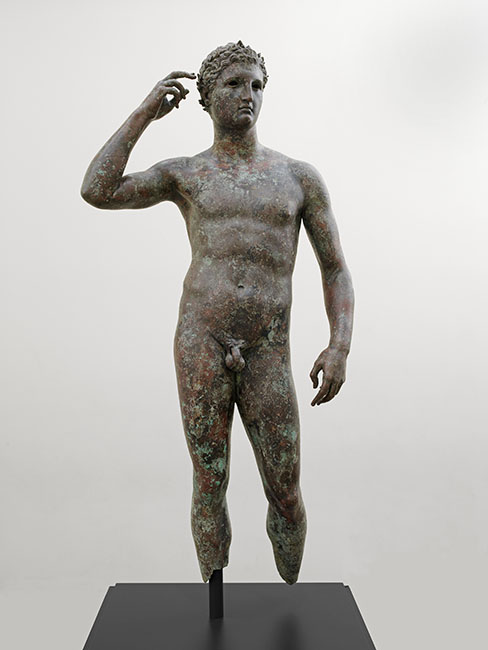 During Leila’s talks with Signore Fiorilli, they reviewed files on the Getty Bronze and discussed some of the challenges in the litigation. That year (2010), an Italian judge found that the bronze was smuggled out of Italy, and he ordered the Getty to return it. (A discussion of the ruling can be found in a piece Leila authored in 2011—pages 30-32 of this newsletter). The return never happened.
Then in 2019, the Corte Suprema di Cassazione (the highest appeal court in Italy) found that Italy owned the statue and ordered the Getty Museum to return it. The basis for the decision was that the bronze was found in Italy’s territorial waters and thus belongs to the country under its patrimony law (Law No. 1089 of 1 June 1939). Alternatively, even if the statue was found in international waters, ownership is based on the theory that the ship transporting the bronze to shore was sailing under an Italian flag. The court found that the Getty never conducted the requisite due diligence prior to acquiring the valuable antiquity.
As anticipated, the Getty never complied with the order from the Italian court. The museum treated it as a foreign decision lacking any enforcement power in the US. But the latest development took place earlier this month when the European Court of Human Rights (ECHR) addressed the dispute. The Getty Trust had filed the matter with the ECHR to challenge the final Italian decision, arguing that the Cassation Court’s confiscation order violated Article 1 of the First Protocol to the European Convention on Human Rights, by interrupting the “peaceful enjoyment of possessions.”

The coast near Fano, Italy (Copyright: Leila A. Amineddoleh)
However, the court sided with Italy, unanimously affirming Italy’s right to seize the statue from the Getty. The ECHR found that the Mediterranean nation was justified in its attempts to reclaim a cultural artifact and that its decades-long battle was not disproportionate. While the court found that the Getty’s right of “peaceful enjoyment” was triggered, Italy was justified in pursuing the bronze as part of its work protecting cultural heritage. The court held that international law strongly favors Italy’s efforts to recover stolen cultural objects, and the Getty did not conduct proper due diligence prior to acquiring the bronze in 1977.
Maurizio Fiorilli said that the ruling is “a victory for culture.” But practically speaking, will the court’s decision have any effect on the bronze and the Getty? Will US law enforcement recognize the order from the ECHR and seize the statue? It’s unclear.
ECHR rulings are binding on states that are party to the court. However, the US is not a party to it. Cultural heritage law expert Patty Gerstenblith has stated that if US courts enforce the judgment, it will “open a huge can of worms for American museums.” While it’s unclear whether the ECHR judgment will be enforced in the US, Italy has a long history of cooperating and collaborating with US parties and institutions, including museums and law enforcement.
Disclaimer: While this law firm has represented Italy in past proceedings and Leila A. Amineddoleh has conferred with Maurizio Fiorilli concerning the Getty Bronze, none of the information in this post includes confidential information or legally sensitive material. All material in this blog post is publicly available.
by Amineddoleh & Associates LLC | May 15, 2024 |
Last week, a painting stolen over forty years ago was finally returned to its original owner, Chatsworth House. The painting, A Double Portrait of Sir Peter Paul Rubens and Sir Anthony Van Dyck (1640s) by Eramus Quelliness II, was stolen on May 26, 1979, and recently discovered at a regional auction house in France. Chatsworth House lent the work to the Towner Art Gallery for an exhibition featuring works by the Flemish Baroque artist Anthony Van Dyck.

Eramus Quelliness II’s A Double Portrait of Sir Peter Paul Rubens and Sir Anthony Van Dyck (1640s). Image via Chatsworth House Trust.
“Smash and grab”
The exhibition did not go as planned. To the public’s astonishment, the gallery fell victim to a “smash and grab” raid after the exhibition. Thieves made off with A Double Portrait of Sir Peter Paul Rubens and Sir Anthony Van Dyck, but left more valuable works behind – causing authorities to believe that the robbery was not well-planned out. While A Double Portrait looked more expensive than the drawings left behind, the original Van Dyck drawings the thieves left were much more valuable (and have sold for upwards of $2 million in recent years).
The thieves may not have been very knowledgeable about art. Even so, they disappeared without a trace. The painting had been feared lost since that night in May 1979.

Interior of Chatsworth House. Image via Chatsworth House Trust.
Miraculous Recovery
Until now!
In 2021, an art historian discovered that the work was listed for sale in the bucolic town of Toulon, France. They reported the finding to Chatsworth House, who happily stepped forward to claim the work.
It’s unclear how the piece made its way from the thieves to modern-day France. The Art Newspaper reports that the painting was sent to Toulon to be sold after the seller discovered it while cleaning out his late parent’s house.
The painting required extensive restoration. Today, the work shines with its former glory.

Collectible from Chatsworth House. Image via Chatsworth House Trust.
The Art Loss Register
This was a happy ending to a devastating art robbery. Art crime continues to plague valuable collections in public and private collections all over the world. To combat the problem, the Art Loss Register (ALR) currently holds and maintains the largest private database of lost, stolen, and looted art, antiquities and collectibles.
Works are added to the registry on behalf of victims of looting and theft, insurers, police forces and other interested parties. ALR also employs a unique due diligence service for their clients who are active in the art market to ensure that they are handling objects that do not have questionable provenance.
The ALR single-handedly provides the art industry’s best risk management tool for those seeking to buy and sell works of art and cultural heritage. Moreover, using ALR’s tools and databases speeds up recovery of missing works, because searching the database enables users to identify works that have been stolen – and to return them to their claimant for recovery.
To read more about how ALR helps its clients search, register and recover lost art, click here.
